The case for the defence

Born 1404
Executed 1440
Exonerated 1992

It is now widely accepted that the trial of Gilles de Rais was a miscarriage of justice. He was a great war hero on the French side; his judges were pro-English and had an interest in blackening his name and, possibly, by association, that of Jehanne d'Arc. His confession was obtained under threat of torture and also excommunication, which he dreaded. A close examination of the testimony of his associates, in particular that of Poitou and Henriet, reveals that they are almost identical and were clearly extracted by means of torture. Even the statements of outsiders, alleging the disappearance of children, mostly boil down to hearsay; the very few cases where named children have vanished can be traced back to the testimony of just eight witnesses. There was no physical evidence to back up this testimony, not a body or even a fragment of bone. His judges also stood to gain from his death: in fact, Jean V Duke of Brittany, who enabled his prosecution, disposed of his share of the loot before de Rais was even arrested.

In France, the subject of his probable innocence is far more freely discussed than it is in the English-speaking world. In 1992 a Vendéen author named Gilbert Prouteau was hired by the Breton tourist board to write a new biography. Prouteau was not quite the tame biographer that was wanted and his book, Gilles de Rais ou la gueule du loup, argued that Gilles de Rais was not guilty. Moreover, he summoned a special court to re-try the case, which sensationally resulted in an acquittal. As of 1992, Gilles de Rais is an innocent man.

In the mid-1920s he was even put forward for beatification, by persons unknown. He was certainly not the basis for Bluebeard, this is a very old story which appears all over the world in different forms.

Le 3 janvier 1443... le roi de France dénonçait le verdict du tribunal piloté par l'Inquisition.
Charles VII adressait au duc de Bretagne les lettres patentes dénonçant la machination du procès du maréchal: "Indûment condamné", tranche le souverain. Cette démarche a été finalement étouffée par l'Inquisition et les intrigues des grands féodaux. (Gilbert Prouteau)

Two years after the execution the King granted letters of rehabilitation for that 'the said Gilles, unduly and without cause, was condemned and put to death'. (Margaret Murray)


Showing posts with label Gilles de Rais. Show all posts

Thursday, 31 October 2024

The Erl-King

O who rides by night thro' the woodland so wild?

It is the fond father embracing his child;

And close the boy nestles within his loved arm.

To hold himself fast, and to keep himself warm.


"O father, see yonder! see yonder!" he says;

"My boy, upon what dost thou fearfully gaze?"

"O, 'tis the Erl-King with his crown and his shroud."

"No, my son, it is but a dark wreath of the cloud."


(The Erl-King speaks)

"O come and go with me, thou loveliest child;

By many a gay sport shall thy time be beguiled;

My mother keeps for thee full many a fair toy,

And many a fine flower shall she pluck for my boy."


"O father, my father, and did you not hear

The Erl-King whisper so low in my ear?"

"Be still, my heart's darling--my child, be at ease;

It was but the wild blast as it sung thro' the trees."


Erl-King

"O wilt thou go with me, thou loveliest boy?

My daughter shall tend thee with care and with joy;

She shall bear thee so lightly thro' wet and thro' wild,

And press thee, and kiss thee, and sing to my child."


"O father, my father, and saw you not plain

The Erl-King's pale daughter glide past thro' the rain?"

"O yes, my loved treasure, I knew it full soon;

It was the gray willow that danced to the moon."


Erl-King

"O come and go with me, no longer delay,

Or else, silly child, I will drag thee away."


"O father! O father! now, now, keep your hold,

The Erl-King has seized me-- his grasp is so cold!


Sore trembled the father; he spurr'd thro' the wild,

Clasping close to his bosom his shuddering child;

He reaches his dwelling in doubt and in dread,

But, clasp'd to his bosom, the infant was dead.


Sir Walter Scott's translation of Johann Wolfgang von Goethe's original German

Illustration by Albert Edward Sterner, 1910

The original can be found here, with literal translation. As we see, Scott has daintified the ending of the poem somewhat, to remove the element of rape. Other translators render these lines more accurately -

"I love thee, I'm charm'd by thy beauty, dear boy!

And if thou'rt unwilling, then force I'll employ."

(Edgar A. Bowring, 1853)


Obviously, this is only a Hallowe'en blog post, mildly entertaining (to those who like Romantic German poetry in translation) and with only a  tangential connection to Gilles de Rais. 

Or is it? 

We know, because I have been banging this drum since I was sixteen, that Gilles de Rais was not Bluebeard. Those who argue that Charles Perrault based his uxoricidal spouse on an alleged child-murderer - rather than, say, the alleged wife-killer Comorre the Cursed - lamely argue that Gilles' story was so horrifying that it had to be bowdlerised for fairy tales. Well, fairy tales were written for adults and they were strong meat, as the Grimms demonstrated. 

And here we see once more folklore out-Heroding Herod. The King of the Alders, like some latter-day Zeus, becomes enamoured of a mortal boy and seizes him to be his cup-bearer or catamite. Scott may shrink from the sexual implications, but Goethe did not. The parallels with the traditional image of Gilles de Rais are hard to avoid.  

I am not the first to point this out. Before he wrote his novella Gilles et Jeanne, Michel Tournier dabbled with the subject in a war story called Le Roi des Aulnes, (The Erl-King) where the antihero is  Abel Tiffauges and he rides a  horse named Barbe Bleue. To my mind, it is a far better book than Gilles et Jeanne and probably Tournier's masterpiece. And although he throws Bluebeard into the mix, probably to elucidate matters for the dim ones at the back of the class, he is quite clear: Gilles is the Erl-King. 


 For those who just can't get enough of the Erl-King, here is a blog on the subject, which includes the Bowring translation. 

POSTSCRIPT There is a strong link between the Erl-King and the Wild Hunt, as this story illustrates -

"A tale was told in Devon, England of a farmer who returned late one night from Widecombe Fair, somewhat the worse for the ale he had drunk, but able to guide his mare along the muddy lanes that led to his village. Wind raged in the trees around him, and flashes of lightning bleached the rattling branches. When rain began to fall, he pulled his hat down to protect his face and neck.

At length, he found his horse knee-deep in yelping hounds. The dogs danced impatiently at his stirrups. He looked up: A black-clad huntsman stood motionless before him, astride a gleaming black horse. The huntsman’s own broad-brimmed hat hid his face in the shadow. There were bodies – of what animals the farmer could not tell – slung across the huntsman’s saddle.

The farmer noted the great lord’s booty and, in his distinctly bibulous state, cackled with laughter. “Huntsman, share your spoils,” said he.

The huntsman looked down at him and shrugged and laughed in his turn. He tossed a parcel at the farmer, wheeled his horse and disappeared into the night, taking his hounds with him.

With rain-slicked hands, the farmer fumbled at the parcel. The wrappings fell away, and the man started violently. The parcel held the body of his small son, blue and stiff. Yet when the farmer blinked and looked again, all he saw were his own wet hands. He kicked his mare and sped home as fast as the beast could travel. His wife awaited him, wailing. The infant boy she held in her arms was dead."

The version I know relates to the Gabriel Ratchets, the belief that the strange barking sound of skeins of geese flying overhead in autumn is in fact the hounds of the Wild Hunt. A peasant was sitting by his fire and heard them fly over, and like a fool he shouted "Huntsman, share your spoils!" There was a loud crashing noise as something fell down the chimney - it was half a human torso. For some reason I prefer that version, although the other is arguably darker.

I have never found my version anywhere, and nor can I find the book I quoted the Devon story from. So if you do go down that rabbit hole, let me know if you find either. 


Monday, 16 September 2024

Gilda Rice, the Dark Knight of Paris, and other AI Horrors

YouTube has looked favourably on Artificial Intelligence for some years, but it is only quite recently that it has impinged on my little corner of history. Over the past few months a suspicious number of shorts about Gilles de Rais have been appearing. They all have brand new illustrations, although they mostly do not look particularly fifteenth century.. 

The main giveaway is that the integral subtitles, and sometimes even the titles themselves, are laughably misspelt. So we find -
Giold de Rais
Gilda Rice
Jilas Derais
Gillister Rice
Gil Dorae
Giladerese
Gila Deriz
Giel da Reyes
He is routinely called Jill. At one point his surname is rendered as Darius.
Prelati is once memorably rendered as "Pilate". 

Please note, these are not the auto-generated subtitles YouTube provides, which are routinely hilarious. These are part of the videos and cannot be turned off and on. 

So far so funny, but the content is similarly distorted. Bizarrely, Gilles is executed by guillotine in one video. AI really cannot cope with his mode of death, so he may be hanged, burned, hanged and burned (not necessarily in that order), or sentenced to be burned but the sentence commuted to hanging.

One of his alleged crimes is "prostitution", apparently. There is a reference to Brittany, France, which is as wrong as it gets. The title I borrowed for this post is real; there are now people in YouTubeland who think that Gilles (or Gilda) stalked the streets of Paris like a French Jack the Ripper. For the record, Paris was occupied by the Burgundian allies of the English; Jehanne was unable to liberate it and Gilles never set foot inside its walls. 

Certain phrases, mostly connected with satanic rituals and a descent into infamy, are recycled endlessly. AI clearly feeds on clickbait, and when it starts feeding on itself we shall really see some fun. 

And if this is happening to Gilles de Rais, imagine the other disinformation being created out there, and the knuckle-dragging mouth-breathers who will swallow it unquestioningly. 

Now more than ever, just because you read it on the internet does not make it true. Caveat lector.


Gilles de Rais rides a bike in Hartlepool, AI image courtesy of David J Allenby 


Tuesday, 30 April 2024

Mythbusting #2


That there was a book so lurid that reading it tempted Gilles de Rais into crime

While sorting out the Gilles de Rais myths that need busting, I decided to give low priority to the Corrupting Book that supposedly triggered his crimes. That particular myth had died out, I thought.  Jacques Heers was peddling it in 1994, but that was thirty years ago and Heers is not as well thought of now as he was then. 

And now, voilà! Up it springs again, undead, complete with a "quote" to support it. 

The story, invented by the Bibliophile Jacob, is that  Gilles possessed an illustrated copy of Suetonius' The Twelve Caesars, which was the inspiration for his depravities.  Lacroix has Henriet, as his librarian, translating it to him and Gilles, aroused, committing his first crimes the same night. Bossard  enthusiastically adopted this narrative 

Anybody who has looked into Suetonius will know that there are some highly lubricious anecdotes about the Emperors, Tiberius especially. Those who claim that the Inquisition could not possibly have imagined the acts attributed to de Rais should note that  there were precedents. And also that Suetonius' claims, too, have been disputed. The human imagination is far more versatile than folks think. 

One can see why someone trying to craft a compelling story out of the trials of Gilles de Rais might want to make up a back story to account for what would otherwise be quite inexplicable atrocities. For there is a gaping hole at the heart of the allegations against Gilles - the little matter of motivation. We are offered three motives, which conflict with each other. So did he kill for pleasure? Or was he sacrificing children to the Devil? Or, as the ever-practical Henriet asserted in a seldom-quoted aside, simply to ensure that his victims could never tell tales? 

Some writers have attempted to square the circle by asserting that Gilles started with child sacrifices and grew to enjoy the bloodshed. Unfortunately, this clashes violently  with the timeline. The murders are alleged to have started in 1432 at the latest; it was Prelati who suggested offering body parts to the Devil, and he only arrived in mid-1439. This offering up of the hand, heart, eyes and blood of an already-dead child is the only example of anything resembling human sacrifices. The whole Satanic Rites of Bluebeard narrative is based on a few headers in the civil trial, and these were almost certainly added at a later date.

This is the confected quote that is suddenly appearing in a number of online articles -

Là-dessus, je décidai d'imiter lesdits Césars, et le même soir, je commençai à le faire en suivant les images reproduites dans le livre... »

[Whereupon I decided to imitate the aforesaid Caesars, and that same evening, I began to do so by following the images reproduced in the book...]

These words do not appear in the trial record or in any other contemporary source. They were written in the mid-1980s by historian Maurice Lever, closely following the myth created by Paul Lacroix, the Bibliophile Jacob. Please note that although Lever was an historian, his period was the 17th and18th centuries, not the 15th. M. Lever had never laid eyes on the trial documents, far less studied them. Why would he? He was merely referencing Gilles in a book, Les Bûchers de Sodome, dealing with the criminalisation of homosexuality. 

 The quote is bogus, as is the whole narrative. It illustrates how little respect even genuine historians have shown for the truth about Gilles de Rais.

Further reading -

The Bibliophile Jacob

The AI image at the top of the page is taken from Reddit, with thanks. 

Saturday, 20 April 2024

Mythbusting: check out that cliché!


 The most recent blog post is the first in what may well be a near-endless "Mythbusting" series, which will eventually have its own separate page. Inevitably, there will be some repetition. Some posts will probably be what my nemesis, Wikipedia, calls "stubs", concisely stating the facts and linking through to other posts where the matter has been discussed in detail.

This is necessary because, with the traditionalist rawhead-and-bloody-bones propagandists on the back foot, most of the disinformation comes from amateur commenters on social media who base their theories on moonshine and fairy dust. These ignorant assertions must not be allowed to stand, because if unchallenged they will spread like the plague, and having counter-arguments readily available will help me and others to quash them.

There is more absolute tosh written about Gilles de Rais than almost any other subject. For more than five hundred years, what little was written about him was fictionalized. When, in the late nineteenth century, he finally received what is often (erroneously) called an "authoritative" biography by Eugène Bossard, many errors were simply baked into the narrative. Bossard was not a historian: he was writing a thesis in the discipline of French literature. He has Gilles born in the wrong place (Machecoul rather than Champtocé), claims his mother remarried when she actually died, gets the birth year of his brother René out by seven years, and repeats as fact several legends about the corrupting book, the dead fiancées, and the veiling of the crucifix. Later biographers merely copied his errors rather than doing their own studies. 

The word cliché was originally a technical term from the early days of printing When pages had to be set up laboriously with metal type, a word that was often used was kept ready made so that it could simply be dropped into the text to save time. This is exactly how the internet works. A particularly juicy piece of misinformation will be C & P-ed everywhere. This was how a monumentally sloppy piece of Wikipedia editing became a sex act so shocking that even the Inquisition couldn't invent it - "he cut their heads off and ****ed the hole!" This little gem still crops up here and there occasionally. 

The people who repeat this drivel have never read the trial record. Some of them may never have picked up a book since they left school. They steal whatever appeals to their perverse little minds, without question or comprehension. The pieces of clickbait they steal may well have been already stolen and edited, and will be stolen and edited in their turn in a nightmare process of Chinese whispers. 

So whenever you see a literal cliché, a phrase that pops up unchanged on various sites, you are seeing undigested data that is almost certainly wrong. That there were no mediaevalists involved in the 1992 retrial, that Gilles was born "no earlier than 1405", that "most historians" believe that he was guilty... No thought at all has gone into cutting and pasting these stock phrases. Proceed with caution.  


IMPORTANT NOTE: I hope it is abundantly clear that this blog is a resource. Use it however you want. Feel free to link to it, quote it, refer to it, paraphrase it. This information needs to be out there. Spread the word, with my blessing and my thanks. 


Sunday, 7 April 2024

Mythbusting #1

That human remains were found in any of the castles of Gilles de Rais either during his lifetime or more recently

One of the most common tropes in online discussions is "but bodies were found!" This is largely because of the Chinese Whispers effect, and also because Joe Public is unable to distinguish between evidence and allegations.

The prosecution claimed that "suspicious" ashes and a bloodstained, stinking child's chemise were found at Machecoul. Not, please note, in the château as you might expect, but in a small hovel of ill repute on the outskirts of the village, where Blanchet and Prelati lived for a short time. Nobody has ever claimed that any murders or magical operations took place there or that Gilles ever visited it. It was a tiny building with, obviously, a correspondingly small fireplace and chimney, so burning bodies to ashes there would have been completely out of the question. 

The other allegation that is regularly treated as indisputable fact is the supposed discovery of a barrel" or "conduit" (the word used is ambiguous) full of children's bones at Champtocé. This has entered into contemporary myth to the point where a 1900 fantasy picture of Gilles' arrest has become current on the internet. The image shows him pinioned, brutish and hangdog,  watching while a barrel of bones is tipped over in front of him. It goes without saying that nothing of the kind happened


The myth of the cache of children's bones comes in the testimony of Guillaume Hilairet, an interesting serial witness who is also named as a "person of interest". He did not, himself, see the thing he reported, he was merely repeating what he was told by one Jean Jeudon. It is, in fact, classic ouϊ-dire (hearsay) evidence. M. Jeudon, like all the alleged eyewitnesses, does not appear in court. 

Many of the people who claim that "bones were found" imagine that they have been found recently. Occasionally somebody asks if the castles have been excavated and whether skeletal remains were dug up. Indeed, there have been excavations, unsurprisingly. Nothing incriminating has ever been unearthed. 

Here is a recent post about excavations of the sousterrains of Tiffauges. Inevitably, one ghoul could not contain herself & was politely but firmly told: No. No bones at all. Other commenters challenged her about the Champtocé claim. She was unable to defend her assertion. 


Further reading -


Monday, 18 March 2024

The Template of Normality


Just a little funny to let you all know I'm still here and still working towards the complete rehabilitation of Gilles de Rais. Expect more blog posts soon.

These stills were taken from Edmund Stenson's beautiful little short film, The Martyr, which you should watch if you haven't seen it already. Yes, that is me, & yes I do talk just like that, this was unscripted. 

Saturday, 4 February 2023

The Martyr - an update

 In 2020 I announced that The Martyr, a short film by Edmund Stenson, would be "coming soon". On reflection, "soon" was a bit optimistic. Before it could have a permanent home on the internet, it had to do the rounds of the film festivals, most of which it was a tad too weird for. However, it did win Best Short Documentary at both Atlanta Shortsfest and FilmQuest.

It will take up 15 minutes of your time and is well worth it. You get to see me, and my dolls, and my Collyer brothers style home. And there are delightful illustrations by Robbie Ward, like the one below. 


It is available free-to-view in two places - 

YouTube  https://youtu.be/LBYgr7L-NSk

and Vimeo  https://vimeo.com/717518870 

from February 4th 2023.

Do watch, enjoy, and share. Reviews and comments welcome. 


Wednesday, 28 December 2022

A Childermass conundrum

At Orléans in 1434 Gilles de Rais  is supposed to have signed an infamous procuration, or deed of attorney, that put the management of his finances into the hands of Roger de Bricqueville. There are several reasons to be suspicious of this document. Firstly, there is no proof whatsoever that Bricqueville was in Orléans; he & Sillé are both omitted from the list of Gilles' entourage. Secondly, the document was dated 28th December, Holy Innocents Day, which, given that Bricqueville was accorded the right to marry off the infant Marie de Rais to whoever he chose, strikes an ominous chord to many writers. However, Gilles is consistently presented to us as a superstitious man, and Holy Innocents Day, or Childermass,  was regarded as the unluckiest day of the year, so ill-starred that the day it fell on was deemed unlucky for the whole year. Any enterprise begun on it would be doomed to failure. It seems highly improbable that Gilles, as a man of his time and one who particularly venerated the child martyrs, would have risked entering into such a vital contract on that day of all days. Also, it should be noted that Bricqueville never did arrange a marriage for young Marie, even though she was a good match; her late great grandfather Jean de Craon would certainly have found her a husband with no qualms at all. 


The Coventry Carol - "Herod the king in his raging..." 


Le Massacre des Innocents by Nicolas Poussin, 1628


Sunday, 10 July 2022

Beyond Copypasta


Time for another Bluebeardery and Copypasta post, I think, as we've been serious for a long time.

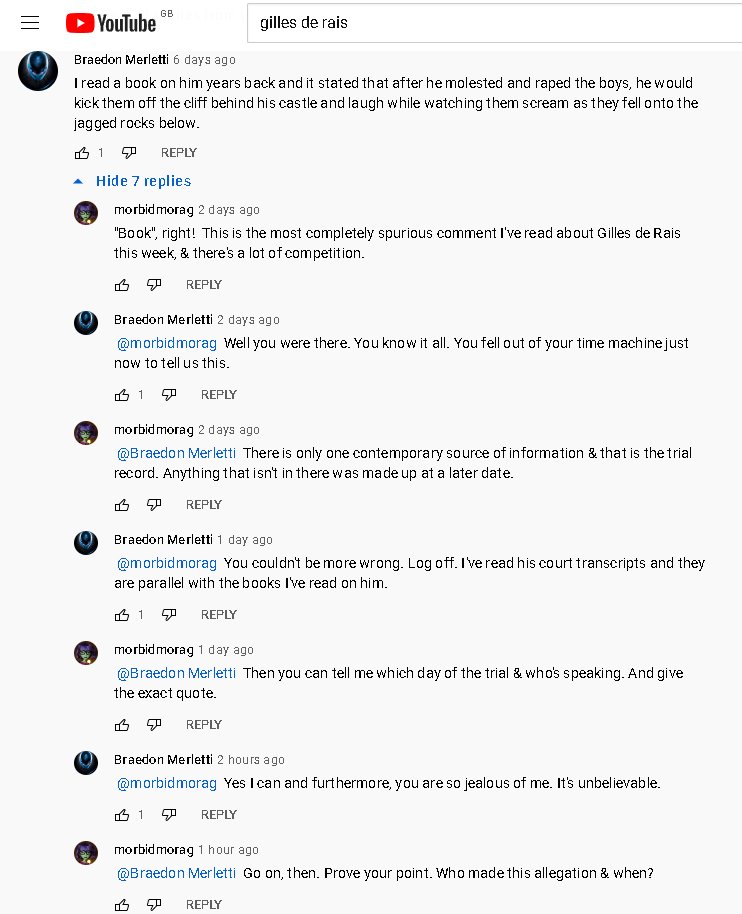
Some people come up with the most bizarre ideas and I'd love to know where they get them from -

But, sadly, they never tell me. They drift off, never to return. A proper cliff-hanger, you might say. 

Some commenters have noticed that the Shrek villain Lord Farquaad looks like Gilles de Rais, though they usually get it back to front and wonder why Gilles de Rais looks like Farquaaad. Clearly because Eloi Féron way back in the 19th century took his influence from Disney, dude. Others go even further astray -


Obviously, a topic like this offers great opportunities to be as edgy as hell, but that only works if nobody pops up to tell you how you got it all wrong -


It's important to point out to me how very weird I am for caring about the most egregious historic miscarriage of justice of all time -

And that old chestnut, "Gilles de Rais is my ancestor!" Which doesn't give them quite the épater les bourgeois distinctiveness they imagine -

I often think I should organise a get-together of all his descendants. Might be fun. 

Selection of idiocies -


Finally, the kind of foot-stamping that always draws me in -


Why do I respond to these idiots? Because, unless they dirty delete as they occasionally do, these posts are there for good. What I try to do is refute the lies in an entertaining way for future browsers. My motto has always been: seize the narrative. Looking at recent comments on more serious forums, it seems to be working. 

[The comments in this post were taken from Twitter and YouTube]


Sunday, 15 May 2022

Printing the legend

While writing my book, and indeed in this blog, I always avoided following the various Jehanne alternative narratives down their various rabbit holes. This was a deliberate decision. I was heavily invested in the theory of Gilles de Rais' innocence, which was quite controversial when I began my work, and that was enough to make me look eccentric. I didn't need any more conspiracy theories to make me seem like a crazy woman. So - was Jehanne, in fact, a by-blow of nobility? Other than pointing out that she was not a lowly peasant but a gently-raised girl who certainly never tended the flocks, as she herself  indignantly asserted, I didn't go there. On the vexed issue of the False Pucelle, Jeanne des Armoises, I had no choice, since Gilles espoused her cause, but I took a conservative view -

The question must be asked: could Claude des Armoises have been the real Jehanne, somehow saved from burning? Rumours of her survival had proliferated from the moment of her death, and one chronicler wrote finalement la firent ardre publiquement, ou aultre femme en semblable d'elle [finally she was burned publicly, or another woman who looked like her], allowing for the possibility of some substitution. Francis Leary admitted that the only way this could have been done was before the handover to the English, since they had only seen her from a distance, in armour and helmet, and had little idea what she looked like. According to this unlikely theory, a false Jehanne stood trial and went to the stake in her place. Even Leary finds this scenario improbable, and a substitution at the last minute would have been next to impossible. Sadly, it is almost certain that the real Jehanne was handed over to her enemies, subjected to an unfair trial and executed. As we have seen, Gilles' own behaviour encourages this melancholy conclusion: he behaved consistently like a man bereaved and plunged into the deepest depression. He may have been temporarily fooled by a False Jehanne, or he may have used her knowingly for his political ends. But in the end, she was a forgery, like the tinsel that Prelati tried to pass off as gold.

[From my book, The Martyrdom of Gilles de Rais]

These contentious issues were addressed directly in a 1961 book called Operation Shepherdess, by André Guérin and Jack Palmer White, described as "ineffably surreal" by The St Joan Centre. For many years I had a copy of this book on my shelves but, inexplicably,  I never read it. Then, a decade or more ago, it disappeared during a house move. I searched diligently, but it never reappeared, and I didn't need it for the book so I put it to the back of my mind. Recently I thought I might buy another copy - it's long out of print but not hard to obtain - and finally get round to reading it. 

Well. A quick flick through the index soon explained why I didn't bother with it all those years ago. From a promising start, the text went off the rails in the third sentence - "Moscow"? What?

... Gilles de Rais, whom Charles VII named Marshal of France after the Coronation in 1429, when de Rais was but twenty-five.

A very wealthy Breton, the newly honoured Marshal assembled about him workers of precious metals, silversmiths, jewellers, weavers, lace-makers and engravers of arms, also clowns, monks, troubadours, astrologers, and alchemists. [So far, so good.] The renown of his library reached Moscow. The councillors of Henry VI of England modelled the royal stables on his. Eventually, however, he fell into the hands of unscrupulous magicians, necromancers, sorcerers, and sundry mountebanks. Increasingly excited by them, he drove the artists away and, in the countryside around his château, inaugurated a reign of terror which ended only when he was hanged and burned by the Duke of Brittany at the age of thirty-six for having offered up to the Devil numberless women, especially his wives, and over 1,000 small children. Because he not only refused to be clean-shaven like the rest of the courtiers but had recourse to dye, he was popularly known as Bluebeard.


Numberless women! Wives! A thousand children! Bluebeard! This, of course, is the heavily mythologised version of Gilles that prevailed in the early sixties - Klossowski's modern French translation of the trial record was not published until 1965. It is painfully clear that, however deeply the authors researched Jehanne, they spent not even five minutes on her second in command. The notorious beard betrays its Shavian origins - Gilles is seen  "sporting the extravagance of a little curled beard dyed blue at a clean-shaven court", and, like Shaw, the authors thereafter routinely call him Bluebeard.

Perhaps, like me, Guérin and White merely wanted to concentrate on their protagonist without being distracted by the peripheral characters. However, they could not have provided a more salutary example of the dangers of printing the legend: when the reader comes across a serially polygamous, uxoricidal, beard-dying Gilles de Rais on page twenty of Operation Shepherdess, how likely is that reader to believe anything else in that text? 


Monday, 7 February 2022

A Likely Story #7

One of the most spectacular set pieces in the allegations against Gilles de Rais is the ferrying of forty decaying cadavers downriver, from Champtocé to Machecoul, for cremation. Bossard paints a delightful picture of this episode, with the barge waiting under the willows; Prouteau sardonically calls it a barque dantesque. In the prosaic words of the trial record, we merely have Henriet remarking that the remains were transported "by water". 

The reasons for this Gothic journey need not detain us long. Gilles was about to hand the castle of Champtocé over to the Duke of Brittany; for complex political reasons, this could only be done by pretending to take it by force from his brother, who was currently occupying it. The token army of about twenty men was accompanied by the Chancellor of Brittany, Jean de Malestroit, presumably to oversee the handover. So everything that took place happened with Gilles' future judge on the premises, an embarrassing fact that is often glossed over. 

None of this is disputed, although the date is unclear. Most commentators have it as June 1438. So in all probability, the Dantean barge processed down the Loire with its cargo of dead children at the height of summer, when nights are short and days long. Note too that Machecoul was supposedly taken by René de la Suze in November 1437; there is no record of how or when Gilles reclaimed it. 

Now, René de la Suze had been living at Champtocé since October of the preceding year, so obviously the bodies were hidden in a reasonably safe place. For some reason, however, Gilles feared that they would be uncovered by Jean V, so it became necessary to exhume and dispose of them. They could hardly be burned on the spot - remember, the Bishop of Nantes was there and might have noticed. Hence the lengthy process of exhumation and the long journey to Machecoul, which could not be reached by river, so the final part had to be overland. Given the time of year, not all of this process could have been accomplished under cover of darkness.

The bodies were packed in one or two chests (accounts vary) and were burned at Machecoul. Apparently nobody in the castle or the village noticed the stinking smoke that must have resulted. Note that much is made, during the trial, of how the bodies were burned immediately. How a backlog of forty was allowed to build up under a tower at Champtocé, dating back to around 1432 presumably, and nobody ever noticed are questions which are not addressed. 

Gilles de Rais himself was supposed to have accompanied the remains on their final journey, since he was not a man to miss out on inhaling the stench of burning bodies. We are not told how his guest, Jean de Malestroit, felt about being left to entertain himself while his host was mysteriously absent for a period of many hours. Hospitality was important and Gilles' behaviour would have been seen as unspeakably rude. 

The events at Champtocé have an exact parallel at Machecoul in October of the preceding year. When he heard that René had taken Champtocé, Gilles panicked and had (again) around forty bodies exhumed and cremated. None of this is plausible, as Gilles never before or after displayed any fear of the brother who was by far his military inferior, but at least on this occasion there was no need for an excursion by river. The two episodes are so similar that many biographers confuse or deliberately conflate them. 

Gilbert Prouteau boggled at the sheer unlikelihood of the mass transportation of so many decomposed corpses by river and land over a distance of 111.4 kilometres (nearly 70 miles). Nous passons encore une fois les frontières de la vraisemblance [Once more we go beyond the bounds of credibility], he remarked, and it is hard to argue with him. 


Sunday, 2 January 2022

A Likely Story #6

One of the set pieces of the trial is the case of Jean Hubert, aged fourteen, son of Jean and Nicole Hubert, who went missing in 1438. Georges Bataille asserts that, of all Gilles' victims, we know his fate the most precisely; in fact, the converse seems to be the case. At first, the lad's parents gave their testimony together. Their son was employed briefly by Princé, Pierre Jacquet, who was Gilles' herald at arms, but the arrangement did not work out, apparently because Jean was afraid of Princé's horse. He was then passed on to Henriet, who introduced him to a mysterious gentleman known as Spadin, or Spadine. It has been plausibly conjectured that this is a misspelling of the Scottish name Spalding. Henriet spoke of training the boy up as a valet to replace Poitou, improbably said to be leaving Gilles' service. We hear no more of this surprising career move on the part of Gilles' most devoted servant. 

The three internal witnesses – Gilles himself, Henriet and Poitou – are unanimous that Jean lodged at the Hôtel de la Suze in Nantes for eight days before being killed. However, Gilles was absent for four or five of those days. On his return, he was kind to the boy, had him clean his room, and gave him wine to drink and a loaf of bread to take to his parents. Jean did this, and then returned to La Suze. Shortly after, Spadine/Spalding called for M Hubert to ask where the child had gone, and there was an unseemly dispute over who had lost him. The parents made several complaints to Gilles' men and were told that “a Scotsman” had taken their son away. Now, young Jean had already told his parents that he did not want to go back to school because Spadine was going to take him “north” or “upriver”. He stayed with his parents for only one night between employers and seems to have been an adolescent who yearned to escape from his dull home life.

There was a run-in with one Mme Briand, wife of a kitchen employee called Jean Briand; she accused Mme Hubert of saying that Gilles killed her son, which the latter woman prudently denied. Mme Briand made an earlier appearance in the evidence, in relation to the disappearance of a boy named Delit. It is interesting that the conversation with Mme Hubert follows almost exactly the same course as the one with Mme Delit, concluding with Mme Briand's threat or warning that “she and the others would regret it”.

To complicate matters further, Nicole Hubert reappeared alone later in the trial, and contradicted the evidence she gave with her husband. This time, she did not mention her son meeting Gilles at all. The loaf of bread was a present from Spadine; in the earlier testimony, there were two loaves, one from Gilles and one from a servant called Simonnet, though the second loaf was intended for an unnamed woman in town. Princé has been edited out of the story altogether – in Mme Hubert's solo account, her son worked for a man called Mainguy, who died.

This case is unique in that it was affirmed by Gilles, his servants, and the parents of the missing child, among others. The only comparable case is that of Bernard le Camus, although he was reported missing by the man he lodged with rather than a relative.

Reading the accounts given at the trial, it is not easy to work out exactly what happened. Gilles' biographers get round this little difficulty in their usual fashion, by deciding on the narrative and editing out the contradictions. 

Thursday, 25 November 2021

Making a Mediaeval Murderer

Three years ago, the website Dirty, Sexy History published this article by Jessica Cale - Making a Medieval Murderer: The Exoneration of Gilles de Rais. It remains one of the best accounts of the alternative narrative and features a substantial interview with your trusty blogger Margot K Juby.

Old image of  the blogger as a young woman


Wednesday, 13 October 2021

Saints & Sinners: or, why I do what I do

Nobody will be surprised to hear that I have a little Gilles de Rais shrine; it would be more surprising if I didn't.


A few days ago I decided that I would add to it by ordering a candle and a canvas from a company that produces icons of saints with the faces of politicians and also does custom orders. I won't give them undeserved publicity, but will make sure that anyone putting their company name into the search engine will find this post. 

Within 24 hours I had a PayPal refund. Quickly followed by this -

I’m afraid we’ve got a bit of a problem with your custom request. Our candles are fun, irreverent and warmly meant - the subjects usually trigger warm and/or happy feelings – if they make us laugh we’re very gung-ho about making them and putting them out, but the immediate association here is one of pure evil.

We sometimes receive requests that we decline and while we hate not to please our customers, we also have to trust our gut. We don’t always get it right, but I’m afraid on this occasion, our call is not to do it. As a result of this decision, I have refunded your order.

Now, I'm not easily offended by ignorance - I'd have died of outrage several Bluebeardery & Copypasta seasons ago if I were. But this sticks in my craw because of a toxic combination of the judgemental and the hypocritical.

Because you can have a Margaret Thatcher icon - crowned, no less. Boris Johnson, also crowned, waving the butcher's apron. You can even have Priti "sink the immigrant boats!" Patel on a cushion. They're proud of that one.


All controversial politicians. You wouldn't look far to find someone insisting that each one has blood on their hands. All acceptable, apparently.

You can't, however, have Gilles de Rais, because somebody did an image search and clicked on the first site they found, probably Wikipedia. They chose to ignore all the recent developments since 1992 (and, in fact, before). They are blissfully and ironically unaware of the 1925 attempt to have Gilles beatified. Well, you may say, they make candles: why should they be following this somewhat arcane controversy? Indeed. I would argue, though, that they should at least make sure they know what they're talking about before they rudely turn down a £70 order.

I get that they thought I was attempting dark humour. But policing your customers' sense of humour isn't really on, either, is it? In fact, when a bespoke service tries to exercise its freedom of speech to censor its customers, for any reason, it never goes well.

I don't take offence on my own behalf. I'll get over feeling hugely disrespected. I don't think it's a great way to run a business, but it's their business, after all. If they want to turn away trade in a fit of misplaced virtue signalling, that's up to them.

(Although how you can jump on a moral high horse when you're making sizeable profits off the backs of all the photographers whose copyright you are merrily violating is beyond me. Every one of their non-custom items is based on an uncredited photograph).

But I am Gilles de Rais' representative on earth, so I have to make some kind of stand. I have spent a decade or more putting out the truth, with some effect, and what is the first impression someone gets when they search his name? "The immediate association here is one of pure evil". This is why I do what I do. This is why I carry on.


Update: It seems I was right; a business that turns away trade for dubious moral reasons isn't going to last long. This company, which I can now name as My Sainted Aunt, went into voluntary liquidation on February 21st 2022, some four months after my run-in with them. If I believed in karma, I'd be impressed with the rapidity. 

When I looked into the matter, it turned out that there is another company that offers a suspiciously similar product and that has been in business since 2016. So My Sainted Aunt - founded in June 2020 - presumably "borrowed" the idea from them. Delightful people. 

Monday, 30 August 2021

Gilles de Rais: A Case for the Defence (Part 2)

My previous essay on the case for the defence deliberately did not address the grounds to suppose that there was some kind of plot against him. That is a whole other topic which needs to be examined in some detail. The motives of his enemies were not wholly financial, as simplified accounts of the life of Gilles de Rais often imply; politics also featured heavily.

However, the initial impetus behind the machination was property, as Bourdeaut grasped when he titled his book Chantocé, Gilles de Rais et les ducs de Bretagne. Gilles came into the world as a result of politicking over the border castles of Champtocé and Ingrandes and died for the same reason. Jeanne La Sage needed an heir urgently because she was a lone woman and therefore prey to any predatory noble.  And Jean IV, the father of Gilles' nemesis, had long coveted the Rais estates, and those two castles in particular. They were of huge strategic importance, controlling ingress to Brittany by river, but they were also highly lucrative. Their lord could tax the river traffic; Jean de Craon's battles with the Loire boatmen lived on long after him in the form of various lawsuits. Gilles hung on to Champtocé almost until the end, not (as is sometimes suggested) out of sentimentality about his birthplace, but because the revenue it accrued was a welcome source of cold cash.

Brittany was, at this point, effectively bankrupt. At one point the Duke misappropriated the money his late wife had left to have masses said for her soul, because he was lacking in both money and morals. The Rais estates must have looked tempting. In fact, they were so alluring that they were confiscated a good fortnight before Gilles was even arrested: as Reinach remarks, when you give away the bearskin before the hunt starts, it means you have firmly resolved to kill the bear, by fair means or foul. (Quand on cède ainsi la peau de l'ours, c'est qu'on est bien décidé, per fas et nefas, a tuer l'ours.) 

Most biographers argue that, since Jean V had obtained the two castles he particularly craved in early 1438, he had no reason to plot against Gilles to seize the rest of his estates. There is a muddled belief that Gilles was virtually bankrupt and no longer had anything worth stealing. Nothing could be further from the case. In order to acquire the estates he wanted, the Duke had had to exchange them for the entirety of the barony of Rais, which Gilles had sold previously. That was how valuable those particular estates were to Brittany. Once acquired, however, it was by no means certain that Jean V could hold on to them. According to Breton law, the Duke was not allowed to enter into property transactions with his vassals. For this reason he used proxies such as "Jean Pain" and, notoriously, Geoffroy Le Ferron. Champtocé was ostensibly bought for one of his sons. In fact, the lawsuits about the misappropriation of Gilles' properties continued for a century after his death and all of them were eventually restored to the Rais family. 

Jean V had another reason to be doubtful that he could hang on to his ill-gotten gains. The contract for the sale of Champtocé was fiendishly complex and went through several drafts. The final agreement included the clause that Gilles could buy the castle back at any point within the next six years, at the price he had sold it for. Most commentators dismiss this as a motive: the money simply was not there. However, we know that the Duke had at least two spies in Gilles' household - Guillaume Grimaud and Guillaume Sauzaie - who were bribed to persuade their master to sell Champtocé (and, meanly, would not be paid unless they succeeded). It is certain that they would have told him that Prelati was claiming to be close to finding the Philosopher's Stone. If he could turn base metals into gold, money would cease to be a problem for Gilles. 

This, then, is the financial aspect of the plot. As we see, it was not as simple as "follow the money", though it should be stressed that not one sou of the proceeds went to the Church; it was divided between the Duke's sons.


The politics, similarly, appears simple but is deeply complex, hinging as it does on the absurdity of a French war hero on trial in the quasi-independent duchy of Brittany. Charles VII owed his throne to two commanders, Gilles and Jehanne. He had singled them out from the rest by awarding them the highly unusual honour of a border of fleurs de lys around their coats of arms. If both had been executed for heresy, then it might be argued that he had won the crown with the help of the Devil. To smear Gilles was to smear Jehanne and, by extension, the French King. 

Jean V's links with England were strong. Few writers explain exactly how strong they were. After his father died, his mother, Jeanne de Navarre, married the English king, Henry IV; her son, the future Jean V, became a ward of the Duke of Burgundy, one of the staunchest allies of the English. As Duke of Brittany, he operated a politique de bascule which was highly successful: between 1420 and 1427 he switched sides no fewer than five times. During Gilles' trial, he actually signed an important treaty with the English, so it is clear which way the pendulum was swinging at that time, and it was not in a direction favourable to the pre-eminent  French commander standing before a Breton court

Besides, Jean V loathed the Lavals. A 17th century historian, François-Eudes de Mézeray, remarked that the Duke was “very glad to avenge his own offence in avenging that of God”. Michelet adds that he was all the more delighted to strike at the Lavals because the King had elevated the barony of Rais to a county and therefore Gilles from a baron to a count. The Duke had a paranoid fear that the Lavals were plotting against him; in December 1437, while he was negotiating with Gilles for the sale of Champtocé, he dismissed his cooks for fear of poison.  Jean V would never have trusted Gilles completely; he was descended from the Lavals on his father's side and would have carried that name if it had not been for the complex deal that had eventually resulted in a passionately pro-French Laval owning a huge swathe of Brittany. All this must have rankled.

Gilles' judge Jean de Malestroit, usually described as the Bishop of Nantes, was also the Chancellor of Brittany. He was a lifelong supporter of the English, had led several embassies to London, and was strongly suspected of sabotaging the French cause - not least by Richemont, the Constable of France, who in 1426  kidnapped him and flung him into prison. Malestroit's chief aim in life was to maintain the independence of Brittany and prevent it from being subsumed into France, and he rightly supposed that an alliance with England was the best way to ensure this. Unlike the Duke, his allegiance never wavered. 

The important fact to remember is that the French King had nothing to do with the trial of Gilles de Rais. It is impossible to make sense of what happened without understanding the separation between Brittany and France. 

In the end it all came down to property and dirty politics. 

Thursday, 12 August 2021

The Martyr


Links to the film are now dead because the Rhode Island International Film Festival, which was showing it, is over. This blog post will be updated with new links when the film is shown elsewhere. 


Nearly a year ago I mentioned the short film I had been making with director Edmund Stenson and his crew - details and pictures here. It finally airs on Friday 13th August and will be available to watch for a week at this site. It lasts 15 minutes and is free to view. 

"A quirky, docu-fairytale brought to life through hand-illustrated animation, The Martyr paints a sinister-yet compassionate-portrait of two outcasts, and the obsession that binds them."


To my great astonishment, animator Robbie Ward introduced an image of me into the action (albeit with tidier hair): here I am witnessing the execution of Gilles de Rais. This gave me an eerie frisson, as it echoes a dream I had twenty-odd years ago. Nobody in the film crew knew about this, least of all Robbie Ward, who I never met. 

Once again, the link to the film, which is free to watch and will take up just fifteen minutes of your time. Click here


Tuesday, 3 August 2021

Gilles de Rais: A Case for the Defence

Almost everything we think we know about Gilles de Rais has come from corrupted sources and is false. Briefly, up until the late 19th century there was no authoritative biography. Everything written about him was fictionalised and sensationalised. Eugène Bossard, an abbot from the area round Tiffauges, seized on him as a suitably obscure subject for a thesis. His speciality was French literature: he was not a historian. And he was completely ignorant of folklore, which is why his identification of Gilles with Bluebeard is so utterly spurious. Every biographer since has leaned heavily on Bossard, assuming him to be reliable. He is not.

Bossard accepted as genuine a known forgery, the account of the trial penned by Paul Lacroix, "The Bibliophile Jacob". Lacroix was a writer of titillating fictionalized pieces, with a fascination for anything bloodthirsty or lubricious. Many of his inventions have entered later biographies as fact. To complicate matters further, J-K Huysmans plundered Bossard to write his scandalous novel, Là-Bas, and added some myths of his own. Because Huysmans has been widely translated, but Bossard has not, much of the English-speaking world takes its information about Gilles de Rais from the former.

It is often said that "most historians" believe that Gilles de Rais was guilty. There is no evidence for this whatsoever. Nobody has taken a poll. Probably most historians have never given the matter a thought. Certainly, the only historians whose opinion would be more relevant than Joe Public's would be those who specialise in that particular time and place, and preferably those who are acquainted with the relevant documents, a tiny minority. One contemporary historian who fits the bill exactly is Professor Thomas Fudge, who wrote a chapter about Gilles de Rais and researched the subject deeply. He came to the conclusion that it's a troubling case and there are strong grounds to suppose that it may have been a stitch-up.

In general, though, historians have had precious little to do with creating the legend of Gilles de Rais, and are unlikely to have much to do with his rehabilitation. Briefly, there are few primary sources, most of them are compromised and unreliable, and biographers (for the most part non-historians) simply do not look at them. The historical method has been much ignored in assembling the traditional narrative of the life of Gilles de Rais.

The story as it is presented to us has been cobbled together by a process of Chinese whispers, where each biographer copies the others and nobody bothers to check back to the primary sources. Evidence is relentlessly cherry-picked, contradictions and impossibilities ignored. That boy who supposedly disappeared while scrumping apples? Accounts vary, but this was said to have happened either on June 1st or at Easter. Apples? Really? What are referred to as "witnesses" are more properly complainants. The eye witness accounts come from inside his household and were produced by torture. The seventy-odd people who appear in court are, for the most part, not parents of the allegedly missing children. They are giving hearsay evidence. It's often as lame as "I saw a man in Machecoul looking for his son" or "I used to see these two brothers working the fairs, but I haven't seen them for a long time." Even Bataille (not a historian) naively points out a whole slew of children who apparently went missing from Machecoul when Gilles was living at Tiffauges. Those sinister old procuresses who fill the gap by ferrying boys across country? Not mentioned by any of the insiders when they were listing the other accomplices, and not produced in court even though (apparently) arrested.

In no particular order, some of the easily-dispelled myths about Gilles de Rais -

The most notorious fib, copied by Bossard and passed on to almost all of his successors, is that there was an illustrated Suetonius that had a corrupting effect on Gilles. There is evidence that such a book did not even exist at that time, but even if it did it would be irrelevent. The Suetonius story does not come from a primary source, it is a mid-19th century confection.

Another legend, which has been quoted as fact by many writers (including, shamefully, the historian-biographer Emile Gabory) is that the evidence at the trial was so shocking that the Bishop of Nantes veiled the crucifix. This derives from that notorious novel by J-K Huysmans; he got the idea from Lacroix and changed it for dramatic effect. Lacroix had Pierre de l'Hôpital covering the cross so that Henriet would not feel inhibited by it as he gave his testimony.

Almost all biographies of Gilles de Rais include the Suetonius or the veiling of the crucifix or both, indicating how very little research their authors did. They simply make no attempt at using contemporary sources. These are mistakes that could not be made by anybody who had done proper research.

At the moment, there is a craze for clickbait sites mentioning the "forty naked bodies" that were supposedly discovered - that is simply not true. At the trial there were allegations that a conduit (or barrel) of dead children was found at Champtocé; there are no eye witness accounts, the evidence was hearsay. No forensic evidence for this or any other accusation was produced in court, which means that a huge number of bodies must have been disposed of without trace. Nobody reported any foul smell or suspicious smoke.

Another falsehood concerns Gilles de Rais' military career. He never executed enemy soldiers. The ones he had hanged were French collaborators - traitors. Every commander did this. Treason was a capital offence.

Also, he never abandoned Jehanne. The army was disbanded after the failed attack on Paris. Joan never saw any of her commanders again. She was fighting her own unofficial war at Compiègne when she was captured; Gilles would probably have known nothing about it. Documents place him at Louviers, just across the river from Rouen where Joan was on trial, in the winter of 1430/1431. La Hire was with him. Both men were at the head of armies. They were in the heart of English-occupied Normandy. Clearly a rescue operation was planned - the English obviously thought so, as they threatened to throw Joan into the river and drown her if any attempt was made to save her.

Another common misconception is that Gilles de Rais confessed freely, without torture. This is untrue. He was not, as everyone insists, given exemption in return for a confession. He was told that if he confessed, the torture would be deferred till the next day, and sure enough there was a convenient gap the next morning, when the court met in the evening instead. There were only two evening sessions; the other one handily occurred after his servants were tortured.

As many people know, there was a rehabilitation trial in 1992, fronted by the Breton novelist Gilbert Prouteau, which acquitted Gilles completely. It was unofficial, and contentious. It did, however, bring the matter to the public eye and has very gradually seeped across the internet to the point where someone will bring it up on a relevant thread. I have been researching Gilles de Rais for many years and feelings about his guilt have definitely changed dramatically in the last twenty years.

See also Gilles de Rais: A Case for the Defence (Part 2)


As stated, the biographies are a poor lot. These two stand above the rest, because they at least acknowledge the possible political and financial motives for a stitch-up.

E A Vizetelly – Bluebeard: an account of Comorre the Cursed and Gilles de Rais (1902)

Jean Benedetti – Gilles de Rais, the authentic Bluebeard (1971)


The revisionist biographies are almost exclusively in French -

Fernand Fleuret/ Dr Ludovico Hernandez – Le Procès Inquisitorial de Gilles de Rais (1921)

Jean-Pierre Bayard – Plaidoyer pour Gilles de Rais (1985, reprinted 1992)

Gilbert Prouteau – Gilles de Rais ou la gueule du loup (1992)


My book, The Martyrdom of Gilles de Rais, was published in 2017

Thursday, 28 January 2021

"I am a direct descendant of Gilles de Rais!"


I’m sorry to have to break it to you, but you certainly are not. Gilles de Rais had one daughter, who married twice but died without issue. The estates that she had, with the help of the King, reclaimed from the Duchy of Brittany reverted to her uncle, René de la Suze. He had one daughter, who produced a male heir. However, the Rais family died out in 1502; Jeanne La Sage’s apparently successful attempt to provide herself with heirs to the estate of Rais had failed after less than a century. 

"God, the Creator, became so displeased with this house, which had been very great, that no children were born to it, and it died out through dissipation, whence sprang thousands of lawsuits, which were still lasting in our life-time."  Bertrand d'Argentré, 16th century

It is not uncommon for anonymous internet commentators to try and enhance their street cred by claiming to be descended from The Wickedest Man In The World. What surprised me was that one of Gilles’ lesser-known biographers attempted a similar trick. Valerie Ogden, author of Bluebeard: Brave Warrior, Brutal Psychopath, explained her interest in de Rais by claiming that she married into a family that is descended from him. Her in-laws “run away” whenever she brings the subject up, however. It is impossible to know whether this is a genuine family tradition, or some kind of in joke, or whether Ogden simply made up the whole story as a publicity stunt. In any case, her decision to go public with it was poorly judged, as it underlines her utter ignorance of her subject. She even alludes to the discredited Bluebeard link by insisting that her husband’s family have “cobalt-blue hair”, presumably inherited from a literally blue-bearded "ancestor"  whose line did not long outlast the 15th century. 

Few things are clear in the complicated story of Gilles de Rais. But this much is certain: if you encounter someone who claims to be his descendant, that person is either lying or deluded. 


Gilles' line ends at the bottom of the chart. 1520 is a typo for 1502. 


Monday, 4 January 2021

Mr Fox - the English Bluebeard

Lady Mary was young, and Lady Mary was fair. She had two brothers, and more lovers than she could count. But of them all, the bravest and most gallant, was a Mr. Fox, whom she met when she was down at her father’s country-house. No one knew who Mr. Fox was; but he was certainly brave, and surely rich, and of all her lovers, Lady Mary cared for him alone. At last it was agreed upon between them that they should be married. Lady Mary asked Mr. Fox where they should live, and he described to her his castle, and where it was; but, strange to say, did not ask her, or her brothers to come and see it.

So one day, near the wedding-day, when her brothers were out, and Mr. Fox was away for a day or two on business, as he said, Lady Mary set out for Mr. Fox’s castle. And after many searchings, she came at last to it, and a fine strong house it was, with high walls and a deep moat. And when she came up to the gateway she saw written on it:

Be Bold, Be Bold.

But as the gate was open, she went through it, and found no one there. So she went up to the doorway, and over it she found written:

Be Bold, Be Bold, But Not Too Bold.

Still she went on, till she came into the hall, and went up the broad stairs till she came to a door in the gallery, over which was written:

Be Bold, Be Bold, But Not Too Bold, Lest That Your Heart’s Blood Should Run Cold.

But Lady Mary was a brave one, she was, and she opened the door, and what do you think she saw? Why, bodies and skeletons of beautiful young ladies all stained with blood. So Lady Mary thought it was high time to get out of that horrid place, and she closed the door, went through the gallery, and was just going down the stairs, and out of the hall, when who should she see through the window, but Mr. Fox dragging a beautiful young lady along from the gateway to the door. Lady Mary rushed downstairs, and hid herself behind a cask, just in time, as Mr. Fox came in with the poor young lady who seemed to have fainted. Just as he got near Lady Mary, Mr. Fox saw a diamond ring glittering on the finger of the young lady he was dragging, and he tried to pull it off. But it was tightly fixed, and would not come off, so Mr. Fox cursed and swore, and drew his sword, raised it, and brought it down upon the hand of the poor lady. The sword cut off the hand, which jumped up into the air, and fell of all places in the world into Lady Mary’s lap. Mr. Fox looked about a bit, but did not think of looking behind the cask, so at last he went on dragging the young lady up the stairs into the Bloody Chamber.

As soon as she heard him pass through the gallery, Lady Mary crept out of the door, down through the gateway, and ran home as fast as she could.

Now it happened that the very next day the marriage contract of Lady Mary and Mr. Fox was to be signed, and there was a splendid breakfast before that. And when Mr. Fox was seated at table opposite Lady Mary, he looked at her. “How pale you are this morning, my dear.” “Yes," said she, “I had a bad night’s rest last night. I had horrible dreams.” “Dreams go by contraries,” said Mr. Fox; “but tell us your dream, and your sweet voice will make the time pass till the happy hour comes.”

“I dreamed,” said Lady Mary, “that I went yestermorn to your castle, and I found it in the woods, with high walls, and a deep moat, and over the gateway was written:

Be Bold, Be Bold.

“But it is not so, nor it was not so,” said Mr. Fox.

“And when I came to the doorway over it was written:

Be Bold, Be Bold, But Not Too Bold.

“It is not so, nor it was not so,” said Mr. Fox.

“And then I went upstairs, and came to a gallery, at the end of which was a door, on which was written:

Be Bold, Be Bold, But Not Too Bold, Lest That Your Heart’s Blood Should Run Cold.

“It is not so, nor it was not so,” said Mr. Fox.

“And then–and then I opened the door, and the room was filled with bodies and skeletons of poor dead women, all stained with their blood.”

“It is not so, nor it was not so. And God forbid it should be so," said Mr. Fox.

“I then dreamed that I rushed down the gallery, and just as I was going down the stairs, I saw you, Mr. Fox, coming up to the hall door, dragging after you a poor young lady, rich and beautiful.”

“It is not so, nor it was not so. And God forbid it should be so," said Mr. Fox.

“I rushed downstairs, just in time to hide myself behind a cask, when you, Mr. Fox, came in dragging the young lady by the arm. And, as you passed me, Mr. Fox, I thought I saw you try and get off her diamond ring, and when you could not, Mr. Fox, it seemed to me in my dream, that you out with your sword and hacked off the poor lady’s hand to get the ring.”

“It is not so, nor it was not so. And God forbid it should be so," said Mr. Fox, and was going to say something else as he rose from his seat, when Lady Mary cried out:

“But it is so, and it was so. Here’s hand and ring I have to show," and pulled out the lady’s hand from her dress, and pointed it straight at Mr. Fox.

At once her brothers and her friends drew their swords and cut Mr. Fox into a thousand pieces.


As part of my campaign to break the spurious link between Gilles de Rais and Bluebeard, here is the story of Mr Fox, the English Bluebeard. There are many, many other tales with similar elements - the forbidden room, the murderous husband or fiancé - but this happens to be a personal favourite of mine. From the delicious sing-song opening - "Lady Mary was young and Lady Mary was fair"- to the final call and response dialogue leading to the abrupt ending, it maintains a perfect tension. 

The significant point about this old folktale is that it is alluded to by Shakespeare in Much Ado About Nothing - Like the old tale, my lord: 'it is not so, nor 'twas not so, but, indeed, God forbid it should be so'. The play was written around 1598 or 1599, and even then Mr Fox was an "old tale". 

Perrault's Bluebeard was written in 1697, almost a century later. It can hardly be said that the uxoricidal spouse trope was invented by him, or indeed that the unknown English author of Mr Fox was inspired by Gilles de Rais. 

The truth is that the Abbé Bossard,  who was writing a thesis in the discipline of French Literature, knew even less about folklore than he did about history. Gilles de Rais had never been compared to Bluebeard until the mid-nineteenth century, when the idea first emerged and was seized on by Paul Lacroix, the Bibliophile Jacob. Bossard accepted Lacroix's clearly forged account of the trial and with it his assertion that Gilles had a literal blue beard and was nicknamed for it. Thus he had an entirely original (because false) topic for his thesis, which was his sole aim. The absolutely bogus link between the folktale ogre and the alleged child-murderer came into being solely because subsequent biographers simply could not be bothered to do their own research, but were content to lean on Bossard's dubious assertions. 

Gilles de Rais was not the original of Bluebeard. 

It is not so, nor 'twas not so, but, indeed, 

God forbid it should be so...


Here is a useful list of folk tales similar to Bluebeard, compiled by the excellent Sur La Lune site. They are categorised as  types ATU 312, ATU 310, and ATU 955 in the  Aarne-Thompson-Uther index.

https://www.surlalunefairytales.com/a-g/bluebeard/bluebeard-related.html